
“I really wanted to be part of the solution.”
Leah Haynie’s path to Austin’s urban forest did not begin under the branches of a favorite childhood tree. It began indoors, with books. At 11, Leah discovered science fiction through her stepfather’s large library, diving into stories about sprawling cities, technology, and futures where people had become disconnected from one another and from nature. Those dystopian worlds stayed with her. Instead of accepting them simply as warnings about what might come, Leah began thinking about how she could help create a different future. “I really wanted to be part of the solution,” she says. That desire eventually led her toward environmental work and, years later, toward a career dedicated to making Austin greener, cooler, and more connected.
“I just crept more and more and more into the tree world until now that’s where I live and work and play.”
Her first job with the City of Austin focused on something Central Texans understand well: heat. Leah joined the City as an urban heat island educator in the air quality program, helping people understand how the built environment can make cities hotter and what can be done about it. Trees soon became an increasingly important part of that conversation. As Leah puts it, she “crept more and more and more into the tree world” until trees became where she lives, works, and plays. What began as an interest in preventing the bleak futures she encountered in fiction became practical work addressing shade, cooling, air quality, and the everyday environments people experience across Austin.


“We were trailblazers in a way, creating these new programs, trying to figure out how to be more proactive, trying to get access to more data.”
By around 2006, that work was becoming increasingly rooted in Austin’s communities. Leah and longtime colleague Emily King helped create Austin Community Trees, an effort that brought them directly into neighborhoods to work with residents and plant trees in shared spaces. Leah remembers this period as especially hands-on. Planting trees was part of the goal, but so was getting to know people and helping neighbors connect with each other. Leah and Emily would go on to collaborate on other efforts, including Tree of the Year, and their professional relationship has continued for roughly two decades. Leah describes them as “two sides to a coin.” Emily often brings a detailed, nuts-and-bolts perspective, while Leah naturally steps back to see the larger picture. That ability to think about where Austin’s urban forest should be heading helped Leah take on one of her most significant projects, writing the Urban Forest Plan.
“I talk a lot about the work I do in terms of translation, because I work with a lot of technical urban foresters and arborists.”
Today, some of Leah’s most important work happens far from a planting site. She describes much of her role as translation. Urban foresters, arborists, planners, and other specialists often work with highly technical information, but residents should not need to be experts to understand why that work matters. Leah helps turn complicated ideas into something people can use, while also managing projects and helping large, sometimes overwhelming challenges feel more achievable. It is a skill she has developed through years of collaboration. Even the healthy friction between colleagues, she says, can make the final work stronger. Different viewpoints reveal things one person might miss. For Leah, communication is not separate from urban forestry. It is part of how people understand the urban forest, see themselves within it, and ultimately decide to care for it.

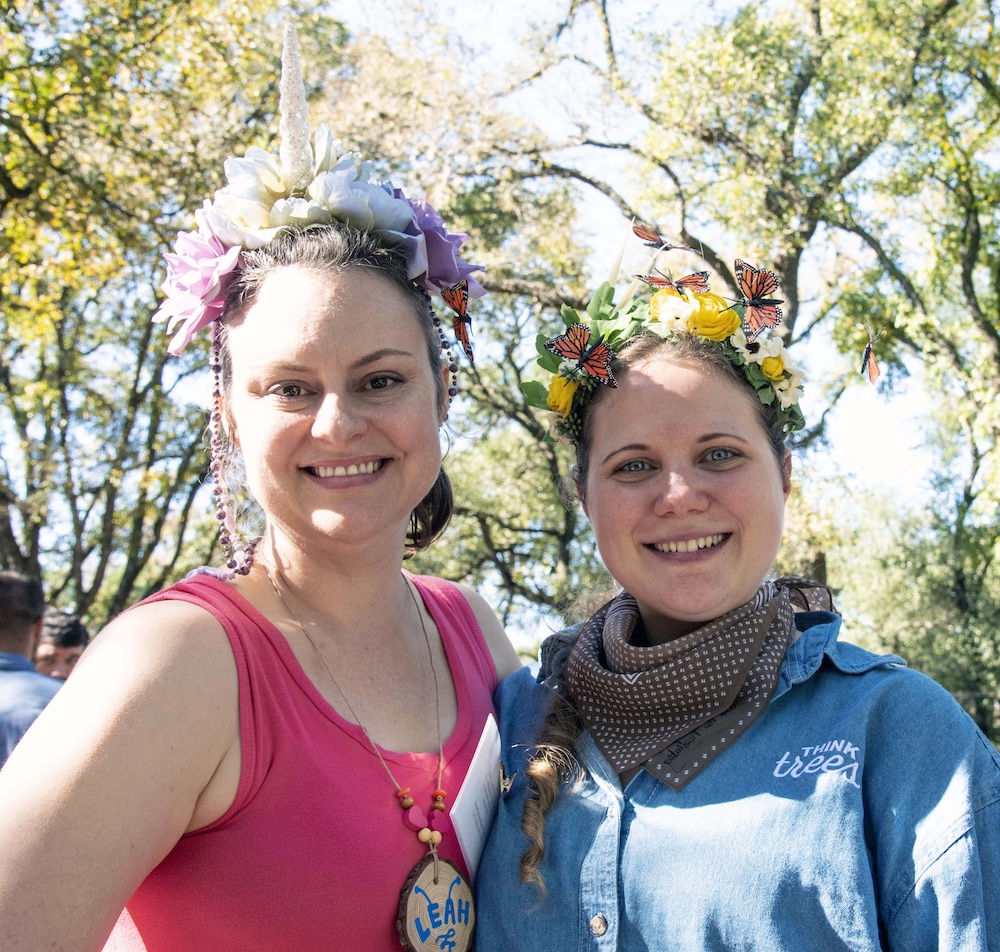
“Teamwork is the best work because nobody can do everything perfectly.”
That big-picture thinking is also visible in one of Leah’s other “babies,” Roots & Wings. After being assigned Austin’s Arbor Day celebration in 2017, Leah began wondering whether the event could become something more. Nearby, Monarch Appreciation Day was attracting many of the same people, forcing nature lovers to choose between celebrations. Leah and colleague Amy Aubin helped bring the events together the following year, but Leah’s vision extended beyond trees and butterflies. She wanted people to encounter the entire urban forest ecosystem, including birds, bats, fungi, pollinators, trees, and the relationships connecting them. She thinks of the experience as “spokes on a wheel,” offering many different ways for someone to discover where their own connection to nature might begin. At its heart, the effort is about something even larger: helping create resilient communities where people know each other, learn together, and find reasons to gather outside.
“People like nature. You can get people to come out for nature… and to my mind, that is a perfect way to bring those things together.”
Decades after science fiction first made Leah wonder what could happen if people lost their connection to nature, she is still using imagination to ask what comes next. She and a colleague are developing an activity book for middle school students that imagines a future Austin without trees and asks young people today to help prevent that future. It brings Leah’s story almost full circle. When asked which tree she would dedicate to Austin, she did not choose a single person or accomplishment. She imagined something that could feed people, perhaps a pecan, growing into a gathering place where neighbors could find shade, share food, have picnics, and simply spend time together. That image captures much of what Leah hopes an urban forest can become. Trees can cool a city, but their value does not end with temperature. They can give people a place to meet, learn, celebrate, and belong. And perhaps that is Leah’s version of a better future: not a perfect city from the pages of science fiction, but a city where people keep choosing, together, to grow something better.

Leah, dreamer of future natures, recommends…
Author
Héctor González, TreeFolks’ Communications Strategy Manager, conducted this interview.
The TreeFolks NeighborWoods Program is a partnership with the City of Austin and Austin Energy.