
“My dad made it a family event… planting this together in our front yard.“
Marcos Martinez’s relationship with trees began long before his career in urban forestry. Growing up in a new neighborhood in the Rio Grande Valley, just north of the U.S.–Mexico border, green space was scarce. There were cornfields, dust, and a few parks. But his father changed that. One day, he brought home two small live oak saplings and turned planting them into a family event. Marcos was only a toddler, but that moment stayed with him. Those two trees are still alive today, growing alongside his family home, rooted in family, care, and hope.
“Those two trees are still thriving and growing, and they’re as old as I am.“
When Marcos’s father passed away in 2021, those memories came flooding back. His dad was not an arborist by trade, but Marcos describes him as a naturalist, someone who paid attention and listened to the land. He taught Marcos how to test soil moisture, how to care for trees, and how to spend time outside with intention. That early connection, and the grief that followed, helped guide Marcos toward a second career in urban forestry. Trees became both memory and motivation.


“Trees were the original critical infrastructure to this planet.“
Throughout our conversation, one idea kept rising to the surface: trees are not decoration. They are infrastructure. Marcos calls them the original critical infrastructure, essential to life long before cities existed. They cool neighborhoods, support health, protect ecosystems, and offer emotional grounding. For him, caring for trees means balancing science with respect. He studies tree health and climate data, but he also approaches trees as living beings. Sometimes that connection is deeply emotional, like the moment he described placing his hand on a massive live oak and feeling the weight of history pass through him.
“Resiliency… is a requirement. We need to create resiliency and adapt to those future climates.“
That understanding of trees as living systems connects directly to Austin’s shift from the Office of Sustainability to Austin Climate Action and Resilience. To Marcos, the name change signals urgency. Sustainability is important, but resilience is about action and adaptation. Climate change is already here, and cities must prepare for hotter temperatures, stronger storms, and longer droughts. The word “resilience” reflects the need to adapt how we design cities, choose trees, and support communities facing the greatest risks.
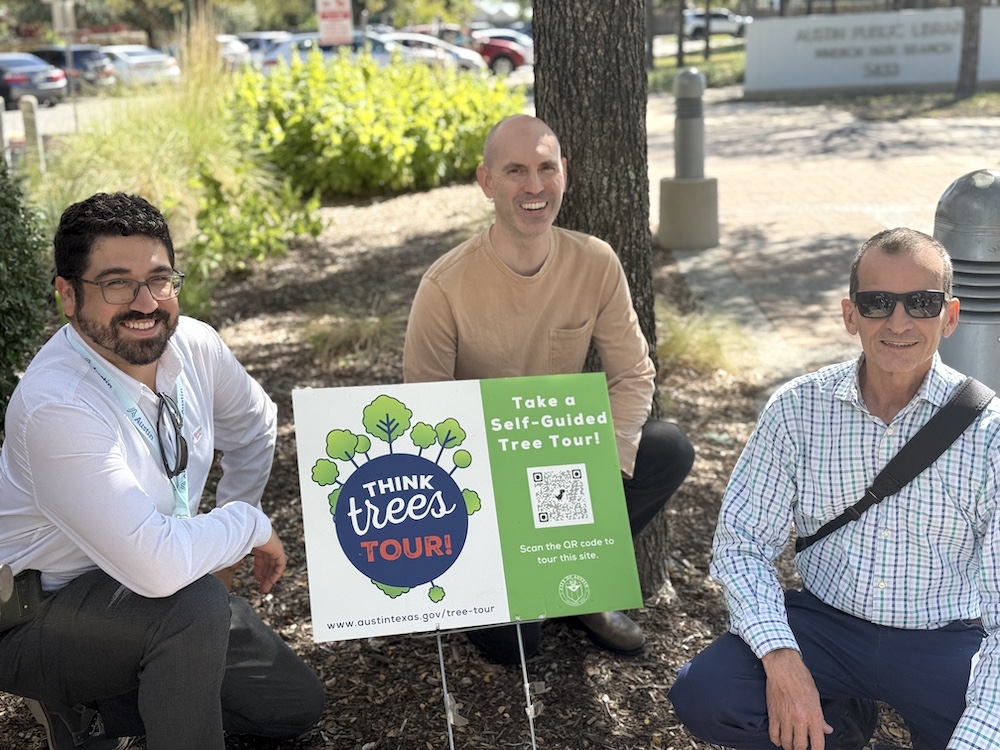

“Arborama is about curiosity, not instruction. Claudia Zapata’s artwork transformed tree education into something joyful, accessible, and deeply human.“
One way that work becomes accessible is through education that feels welcoming instead of overwhelming. That is where Arborama comes in. Inspired by the traditional lotería game, Arborama turns tree knowledge into play. Instead of heavy reports and technical language, people learn through color, storytelling, and joy. Marcos helped guide the vision, urban foresters ensured the science was sound, and artist Claudia Zapata brought it all to life. Their illustrations give each tree personality and beauty, helping people notice differences, celebrate diversity, and feel curious rather than intimidated.
“Ultimately, it’s having fun and recognizing the importance of differences… this beautiful tapestry that is Austin’s urban forest.“
At its core, this work is about healing, both ecological and human. Trees do not grow overnight, and neither does equity. Many Austin neighborhoods still lack shade and green space, and fixing that requires care, time, and collaboration. Marcos believes the work must be done with communities, not just for them, by listening, sharing knowledge, and planting trees where they can truly thrive. Trees, he reminds us, are symbols of hope. When we plant them together, we are investing in a healthier, more connected future for everyone.

Marcos, always the librarian, recommends…
Author
Héctor González, TreeFolks’ Communications Strategy Manager, conducted this interview.
The TreeFolks NeighborWoods Program is a partnership with the City of Austin and Austin Energy.